

What Is Direct Trade Coffee and Why It Matters
You’ve seen “direct trade” on coffee bags, roaster websites, and Instagram captions. It sounds ethical, transparent, and meaningful. But what is direct trade coffee, really? Unlike organic or Fair Trade certifications, there is no governing body that defines it, audits it, or enforces it. That gap between the label and the reality is exactly what most coffee enthusiasts need to understand before they can make genuinely informed choices about what they buy and who they support.
Table of Contents
- Key takeaways
- What direct trade coffee actually means
- Direct trade vs. Fair Trade coffee
- The problem with “direct trade” as a marketing claim
- How direct trade coffee is sourced in practice
- How to verify and support authentic direct trade
- My honest take on direct trade coffee
- Taste the difference that transparency makes
- FAQ
Key takeaways
| Point | Details |
|---|---|
| No universal standard exists | Direct trade has no certifying body, so any roaster can use the label without meeting defined criteria. |
| Relationship depth is the real signal | Authentic direct trade involves named farms, disclosed pricing, farm visits, and multi-year purchase commitments. |
| Fair Trade and direct trade are different | Fair Trade is formally certified and audited; direct trade is relationship-driven with no third-party verification. |
| “Direct” doesn’t mean no middlemen | Exporters and importers remain legally and logistically necessary even in genuine direct trade relationships. |
| Transparency is your verification tool | Look for price disclosures, repeated sourcing from the same farm, and documented producer relationships. |
What direct trade coffee actually means
Direct trade coffee refers to a sourcing model where a roaster buys coffee by negotiating directly with the farmer or cooperative that grew it, cutting out the traditional commodity broker and auction process. The industry term you’ll encounter alongside it is “relationship coffee,” which captures the spirit more accurately. The goal is a personal, ongoing connection between the people who roast the coffee and the people who grow it.
The concept gained traction in the early 2000s, largely driven by Intelligentsia Coffee, Stumptown Coffee Roasters, and Counter Culture Coffee. These roasters wanted more control over quality and sourcing ethics than the commodity market allowed. Intelligentsia’s own direct trade standards include paying at least 25% above Fair Trade minimum prices and making annual visits to origin farms.
In practice, what ideal direct trade looks like includes:
- A roaster visiting the farm in person, often once or more per year
- Price negotiations that happen directly with the grower, not through a broker
- Premiums tied to cup quality scores rather than fixed commodity rates
- Multi-year purchase commitments that give farmers financial predictability
- Published sourcing details on the roaster’s website or bag
The critical caveat: no certification body or universal standard governs who can use the term. A roaster that buys coffee through a regular importer but visited the farm once can legally call it direct trade. A roaster with five years of documented relationships, disclosed pricing, and annual flights to Ethiopia can also call it direct trade. The label covers an enormous range of actual practices.
Pro Tip: When a roaster claims direct trade, search their website for the specific farm name, country of origin, and purchase price. If those details aren’t published anywhere, the claim is difficult to verify.
If you’re curious how origin transparency connects to what ends up in your cup, the role of bean origin in flavor is worth understanding alongside the sourcing story.
Direct trade vs. Fair Trade coffee
These two models are frequently confused, and the difference matters more than most consumers realize. Understanding the direct trade vs. Fair Trade contrast helps you evaluate what a roaster is actually committing to.
Fair Trade is a formal certification administered by third-party organizations like Fairtrade International. It sets minimum purchase prices, requires annual audits, mandates a social premium paid to farmer cooperatives for community projects, and protects workers through defined labor standards. The system is structured, auditable, and verifiable.
Direct trade operates without any of that structure. It’s a philosophy and a practice, not a program with defined rules. Here’s how the two models compare across the dimensions that matter most:
| Factor | Fair Trade | Direct trade |
|---|---|---|
| Certification | Third-party certified and audited | No certification or governing body |
| Minimum pricing | Set minimum prices guaranteed | Negotiated directly, often above Fair Trade floors |
| Verification | Annual audits required | Relies on roaster transparency |
| Farmer benefits | Cooperative social premiums | Potentially higher per-farmer income, no structural safety net |
| Relationship | Systemic, broad | Personal, farm-specific |
| Risk for farmers | Protected by cooperative structure | May lose cooperative support and its protections |
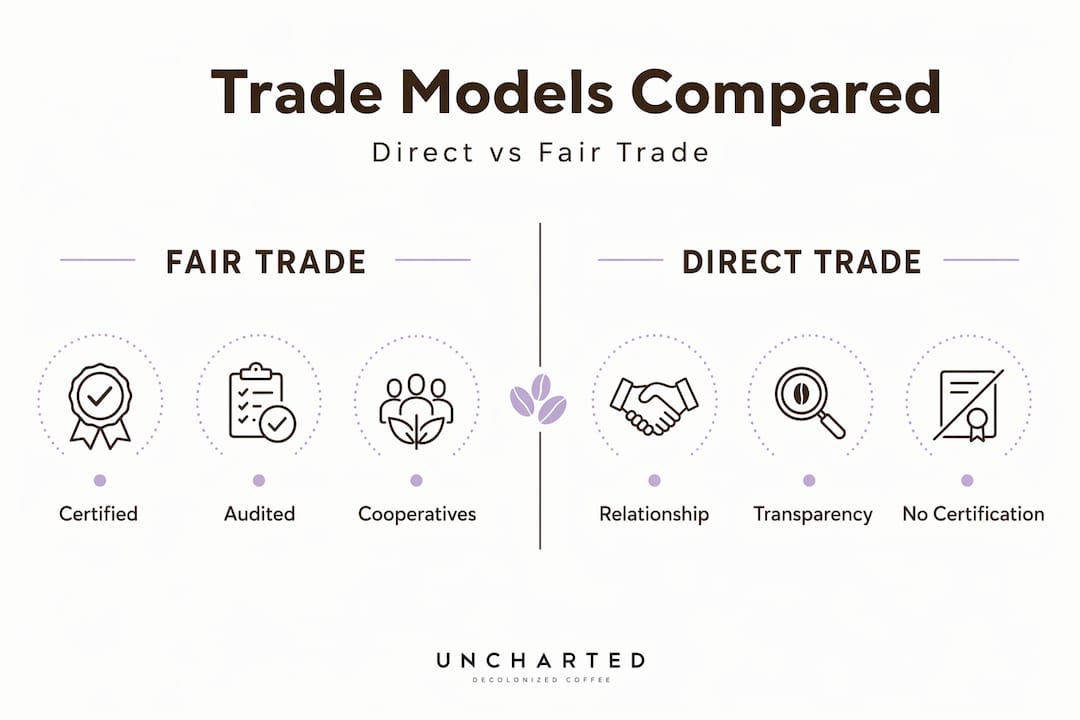
Neither model is strictly superior. Fair Trade provides a safety net that scales across thousands of small farms. Direct trade, at its best, can deliver significantly higher income to specific growers and incentivize quality improvements that Fair Trade’s flat minimum price structure doesn’t reward.
The genuine risk with direct trade is that farmers who leave cooperatives to supply a single roaster lose access to shared infrastructure, collective bargaining power, and the social premiums that fund schools and medical clinics. If that roaster relationship ends or the roaster reduces orders, those farmers can be left without the support system they gave up to participate.
The strongest version of the direct trade model combines its relationship depth with the kind of financial transparency and long-term commitment that mimics some of Fair Trade’s structural protections, without requiring certification fees.
The problem with “direct trade” as a marketing claim
This is where honest analysis gets uncomfortable. Because the term has no regulated definition, it has become one of the most easily abused labels in specialty coffee.
Some roasters use “direct trade” to mean they once attended an origin trip organized by their importer. Others use it to describe buying from a specific cooperative through an intermediary who visited the farm on their behalf. Both are meaningfully different from a roaster who has cultivated a five-year relationship with a specific producer family, visits annually, pays premiums linked to quality evaluations, and discloses exactly what they paid.
The signals that distinguish genuine direct trade from marketing-only claims include:
- Named producers: Does the roaster name the specific farm or farmer, not just the country or region?
- Disclosed pricing: Does the roaster publish what premium they pay above commodity or Fair Trade rates?
- Documented visits: Are there photos, stories, or records of the roaster actually being at the farm?
- Repeat sourcing: Has the roaster bought from the same producer across multiple harvest years?
- Quality feedback loops: Does the roaster share cupping scores and quality feedback with the grower?
“Direct trade is best evaluated as a claim requiring proof, not a label conferring automatic ethical status. The proof lives in transparency and evidence of ongoing relationships, not in the absence of every intermediary.” — sourced from specialty coffee sourcing analysis
Pro Tip: Ask the roaster directly: how many times have you visited this farm? What percentage above commodity or Fair Trade price did you pay this harvest? Roasters with genuine relationships answer these questions without hesitation.
How direct trade coffee is sourced in practice
One of the most persistent misconceptions about direct trade is that “direct” means no intermediaries exist between the farm and your bag. That’s almost never true, and understanding why clarifies what direct trade actually accomplishes.
Here’s how sourcing typically flows, even in authentic direct trade relationships:
- The roaster negotiates directly with the farmer or cooperative. Price, quality targets, and volume are discussed person to person, often during a farm visit before or after the harvest.
- The farmer prepares and processes the coffee according to agreed quality specifications, often influenced by feedback from previous years’ cupping sessions.
- A licensed exporter in the origin country handles the shipment. This is required by law in most coffee-producing countries. The exporter manages documentation, quality inspection, and logistics within the country.
- An importer receives the shipment in the destination country, manages customs clearance, warehousing, and financing. Even the most relationship-driven roasters rely on exporters and importers for these legal and logistical functions.
- The roaster receives the green coffee and begins roasting, often able to reference the specific farm, farmer name, and purchase details because of the relationship built in step one.
The word “direct” describes the relationship layer, not the elimination of every supply chain participant. What changes is where the authority over price and quality sits. In commodity trading, brokers set the terms. In genuine direct trade, the roaster and farmer set the terms together.
When roasters tie premiums closely to quality evaluations and make multi-year purchase commitments, farmers can plan farming practices with genuine confidence. That stability is what makes direct trade meaningful at the farm level, not the theoretical removal of a shipping agent.
For a deeper look at how specialty coffee sourcing connects quality to origin relationships, that context adds useful background.
How to verify and support authentic direct trade
Knowing the theory is one thing. Using it to make better purchasing decisions is another. Here’s how to evaluate what you’re actually buying when a roaster makes direct trade claims.
Look for roaster transparency as your primary filter. The strongest signal of authentic direct trade is whether the roaster names the specific farm and publicly shares purchase and premium details. Vague origin descriptions like “sourced from smallholders in Colombia” without farm names or pricing are a weak signal.
- Check the roaster’s sourcing pages, not just the bag. Many roasters who practice genuine direct trade maintain detailed origin profiles with photos, producer names, and harvest-specific details.
- Use price as a reality check. Deeply discounted “direct trade” coffee priced at commodity rates tells you the economics don’t support a meaningful premium to the farmer.
- Look for multi-year stories. A roaster that has sourced from the same farm for four consecutive harvests has built something real. A roaster featuring a new farm every season might be buying from spot markets with a direct trade label applied afterward.
- Ask before you buy. Specialty coffee roasters with genuine relationships welcome questions about sourcing. Use social media, email, or in-store conversations to ask directly.
Pro Tip: The Specialty Coffee Association’s member directory and community forums are useful resources for finding roasters with documented sourcing practices, especially for enthusiasts new to evaluating origin claims.
| What to look for | Green flag | Red flag |
|---|---|---|
| Origin specificity | Named farm and farmer | Country or region only |
| Pricing transparency | Premium above Fair Trade disclosed | No pricing information |
| Visit documentation | Photos, dates, and stories from origin | No evidence of farm visits |
| Sourcing continuity | Same farm across multiple harvests | New origin every season |
My honest take on direct trade coffee
I’ve spent years reading sourcing claims, talking to people inside the specialty coffee world, and watching the gap between marketing language and actual farmer impact. And the uncomfortable truth I’ve landed on is this: the words “direct trade” on a coffee bag tell you almost nothing by themselves.
What I’ve learned from following roasters who genuinely practice relationship sourcing is that the ones doing it right rarely lead with the label. They lead with the story. They name the farmer. They publish the price. They show you the photos from the farm visit and explain what changed in the processing because of feedback from last year’s cupping.
The ones who lead with the label and follow it with nothing verifiable are, in most cases, using it as a positioning tool rather than a description of actual practice. That frustrates me, not because marketing is inherently dishonest, but because it pulls attention and purchasing dollars away from roasters who have done the hard work of building real relationships.
My view is that consumers who care about ethical sourcing should shift their verification criteria. Stop asking “is this direct trade?” and start asking “can this roaster show me the relationship?” The first question has a yes/no answer that means almost nothing. The second question reveals everything.
Uncharted Coffee’s approach, grounding its sourcing in regenerative and relationship-driven practices, represents exactly the kind of transparency I think the industry needs more of. Not because it carries a specific label, but because it asks coffee to carry meaning alongside flavor.
— Jasmine
Taste the difference that transparency makes
If reading this has made you want to drink coffee that actually backs up its sourcing story, Uncharted Coffee was built for that exact purpose. Every product in the lineup is sourced with the kind of relationship depth described in this article: named origins, regenerative farming practices, and a commitment to what the cup carries beyond caffeine.
The Revive Cold Brew, grown regeneratively in Costa Rica’s highlands, is a direct example of what sourcing with integrity looks like in practice. And if you want to understand the full philosophy behind how Uncharted sources and why it matters, the brand’s mission lays it out without corporate language or vague promises. Explore the full Uncharted collection and find a cup that reflects how you want to live.
FAQ
What is direct trade coffee in simple terms?
Direct trade coffee is a sourcing model where roasters negotiate and buy coffee directly from the farmers or cooperatives who grew it, typically paying above commodity or Fair Trade prices in exchange for quality and relationship transparency. Unlike Fair Trade, it has no certification or governing body.
How does direct trade differ from Fair Trade?
Fair Trade is a formal, third-party certified system with minimum prices, audits, and cooperative social premiums. Direct trade is an unregulated, relationship-based model where roasters and farmers negotiate individually, which can produce higher premiums but offers no structural protections or verification.
Does “direct trade” mean there are no middlemen?
No. Even in genuine direct trade relationships, exporters and importers remain necessary for legal compliance, logistics, and customs. “Direct” describes the negotiation relationship between roaster and farmer, not the elimination of every supply chain participant.
How can I tell if a direct trade claim is real?
Look for named farms, disclosed pricing, documented farm visits, and repeated sourcing from the same producer across multiple years. Roasters with genuine relationships publish these details openly.
Who benefits most from direct trade coffee?
At its best, both the farmer and the consumer benefit. Farmers receive higher prices tied to quality and gain financial stability through multi-year commitments. Consumers get traceable, higher-quality coffee and the knowledge that their purchase directly supported the people who grew it.