

Why Morning Coffee Feels Different: the Science Behind It
There is something unmistakable about that first cup. You already know why morning coffee feels different from an afternoon pick-me-up, even if you have never been able to articulate it. The answer is not simply caffeine content or cup size. It is a convergence of brain chemistry, hormonal timing, sleep biology, and deeply conditioned ritual. Understanding what is actually happening inside your body each morning does not make the experience less magical. It makes it richer. This article unpacks the real science so you can work with your biology instead of guessing at it.
Table of Contents
- Key Takeaways
- Why morning coffee feels different: your brain at dawn
- Cortisol’s role in your morning cup
- How ritual and environment shape the experience
- Sleep quality and why the same cup hits differently
- Coffee’s effects beyond caffeine
- My take: the ritual is the point
- Start your morning with coffee that earns the ritual
- FAQ
Key Takeaways
| Point | Details |
|---|---|
| Adenosine drives morning potency | Higher adenosine buildup overnight makes caffeine’s receptor-blocking effect feel significantly stronger at dawn. |
| Cortisol amplifies alertness | The cortisol awakening response peaks 30 to 45 minutes after waking, layering onto caffeine’s effects to sharpen your senses. |
| Ritual shapes perception | Environmental cues and habitual routines condition your brain to expect and amplify the morning coffee experience. |
| Sleep quality changes the equation | Poor deep sleep caused by caffeine’s metabolites can alter your baseline arousal the next morning, making the same cup feel entirely different. |
| Coffee works beyond caffeine | Polyphenols and fiber-like compounds in coffee influence your gut microbiome, affecting mood and cognition independently of caffeine. |
Why morning coffee feels different: your brain at dawn
Caffeine does not actually create energy. What it does is remove a brake. Your brain accumulates a chemical called adenosine throughout the day, and as it builds up, it binds to receptors that signal fatigue and slow neural activity. Caffeine blocks adenosine receptors (specifically A1 and A2A subtypes), preventing that sleepiness signal from landing. The result is not a surge of new energy. It is the temporary removal of what was slowing you down.
Here is where morning becomes special. After six to eight hours of sleep, adenosine has been accumulating in your brain since you first started waking. Your baseline sleep pressure is at its highest point of the day. That means caffeine has far more adenosine receptors to block first thing in the morning than it would at 3 p.m. The morning caffeine impact is simply more pronounced because the biological contrast is greater.
A few factors shape how strongly you personally feel this:
- Metabolism speed. Genetic variants in the CYP1A2 enzyme determine whether you clear caffeine quickly or slowly. Genetic polymorphisms in this gene partly explain why some people feel jittery on one cup while others barely notice three.
- Caffeine tolerance. Regular drinkers develop partial receptor tolerance, which blunts the subjective alertness effect even as the underlying sleep disruption continues.
- Time since last cup. The longer the gap between your last coffee and your morning cup, the more receptors are available and the stronger the sensation.
Pro Tip: If you want to maximize the morning coffee boost, wait 90 minutes after waking before your first cup. Adenosine levels will still be high, but your body’s own cortisol will have already started its natural rise, giving you a cleaner, more sustained effect.
Cortisol’s role in your morning cup
Cortisol gets a bad reputation as the “stress hormone,” but its morning function is something else entirely. Every day, shortly after you wake, your body triggers what researchers call the cortisol awakening response (CAR). Cortisol levels increase 38 to 75 percent, peaking roughly 30 to 45 minutes after waking. This spike is not a stress reaction. It is your brain preparing your body for the demands of the day, sharpening sensory processing and raising neurological arousal.
Now consider what happens when you drink coffee during or immediately after this window. Caffeine’s adenosine blockade and cortisol’s natural arousal surge overlap. The result is what some researchers describe as a double-up alertness effect, where two independent systems are pushing your brain toward heightened awareness at the same moment.
This is why the coffee sensation in the morning feels qualitatively different from the same cup consumed at noon. By midday, cortisol has dropped significantly from its morning peak. Caffeine is working alone, against a lower adenosine baseline. The morning version of that cup is operating in a completely different hormonal environment.
“The cortisol awakening response is one of the most robust and reproducible endocrine phenomena in human biology. Its interaction with external stimulants like caffeine is an underappreciated factor in how people experience their mornings.”
| Time of day | Cortisol level | Adenosine pressure | Combined alertness effect |
|---|---|---|---|
| 7 to 8 a.m. | Peak (38 to 75% above baseline) | High (post-sleep buildup) | Maximum |
| 10 to 11 a.m. | Declining | Moderate | Moderate |
| 2 to 3 p.m. | Low | Lower (partially cleared) | Reduced |
| 6 to 7 p.m. | Minimal | Low | Minimal |
Individual variation matters here too. Light exposure, alarm versus natural waking, and chronic stress levels all shift the timing and magnitude of the cortisol awakening response. Your morning is not identical to anyone else’s.
How ritual and environment shape the experience
The science of adenosine and cortisol explains a lot. But it does not explain why coffee tastes better on a slow Saturday morning than during a rushed Tuesday commute. For that, you need to understand what context does to perception.
A 2026 MDPI study with 77 participants found that the same beverage tasted more vivid in a real café environment than in a controlled laboratory setting. Sensory perception is not a fixed readout of what is in the cup. It is a construction shaped by expectations, surroundings, and cognitive state. People with a more holistic cognitive style experienced the café environment as significantly enhancing flavor and enjoyment compared to more analytic thinkers, who were less influenced by context.
Your morning routine coffee carries years of conditioned associations. The sound of a grinder, the smell of brewing, the weight of your favorite mug: these cues prime your nervous system before the first sip. Psychological rituals and environmental cues create powerful conditioned responses that heighten perceived taste and emotional benefit. You are not imagining it. Your brain has been trained to respond.
This has real implications for how you set up your morning:
- Consistency builds the response. The more predictable your morning coffee ritual, the stronger the conditioned anticipation becomes. Changing your routine frequently weakens this effect.
- Environment matters. Drinking coffee while scrolling through stressful news is a different neurological experience than drinking it while sitting quietly. The cup is the same. The experience is not.
- Slowing down amplifies flavor. Attention directed toward taste, aroma, and warmth activates sensory processing more fully than mindless consumption.
Pro Tip: Treat your morning coffee preparation as a deliberate 5-minute practice. Grinding fresh beans, controlling water temperature, and choosing a mug you actually like are not indulgences. They are inputs that shape the quality of what you experience. Learning to grind coffee at home is one of the simplest ways to make this shift.
Sleep quality and why the same cup hits differently
Here is something most people do not realize: the coffee you drank yesterday is still influencing how today’s cup feels. Caffeine’s metabolite, paraxanthine, peaks 8 to 10 hours after intake and also blocks adenosine receptors. That means an afternoon coffee at 2 p.m. can still be disrupting your sleep architecture at midnight, even if you fall asleep without trouble.

The specific sleep stage affected is slow-wave sleep, also called deep sleep. This is the stage responsible for physical restoration and cognitive consolidation. Caffeine reduces slow-wave sleep by up to 40%, even when subjective sleep quality feels fine. You may wake feeling rested while your brain has actually underrecovered.
How this plays out the next morning:
- Suppressed deep sleep raises your baseline fatigue. More adenosine has accumulated than a full night of quality sleep would have cleared, making you feel heavier and more dependent on caffeine.
- Tolerance masks the problem. People often develop tolerance to caffeine’s subjective alertness before the underlying sleep disruption subsides. You feel like you need more coffee, but the issue is the sleep debt caffeine created.
- The cycle compounds. More coffee to compensate for poor sleep leads to more sleep disruption, which leads to a higher need for coffee the next morning. The differences in morning coffee experience from day to day often trace back to this feedback loop.
“The feedback loop between caffeine intake and sleep quality significantly impacts daily caffeine sensitivity, explaining why the same coffee can feel different each morning based on prior sleep.”
The practical takeaway is straightforward: your last cup of the day has a longer reach than you think. Cutting off caffeine by early afternoon is not just about falling asleep. It is about protecting the sleep quality that determines how tomorrow’s first cup will feel.
Coffee’s effects beyond caffeine
The conversation about morning coffee effects usually stops at caffeine. That is an incomplete picture. Coffee contains hundreds of biologically active compounds, including polyphenols and fiber-like structures that your gut bacteria find genuinely interesting.
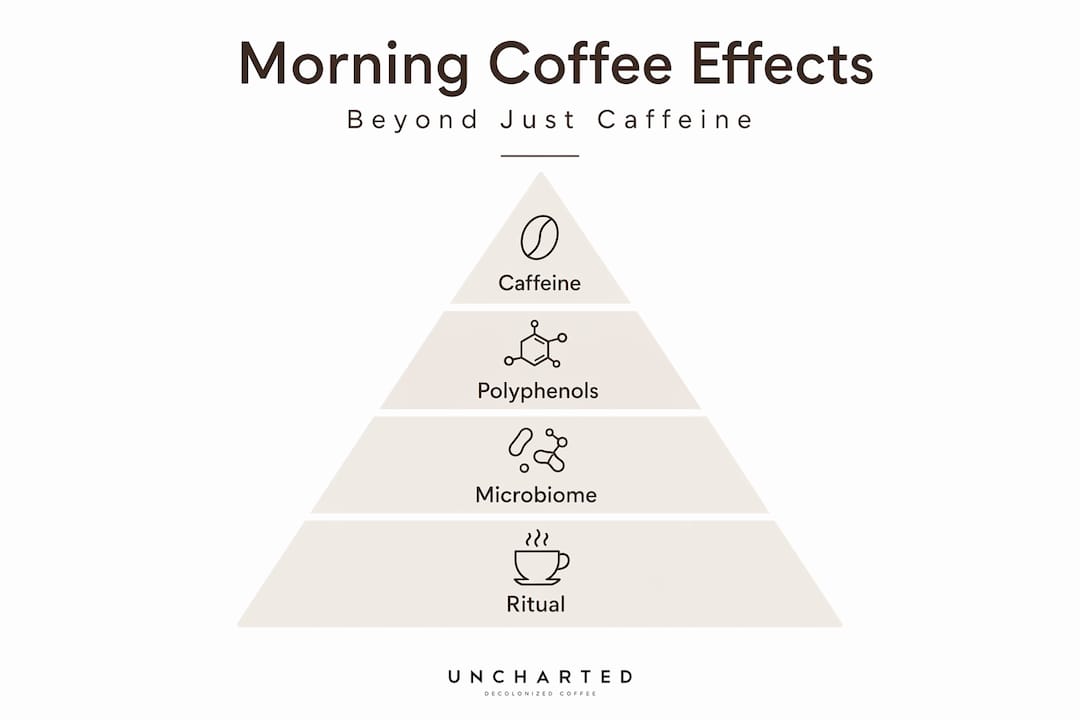
A 2026 Nature Communications study found that habitual coffee intake alters gut microbiome composition, with measurable downstream effects on impulsivity, emotional reactivity, and cognition. The microbiome communicates with the brain through the vagus nerve and via neurotransmitter precursors, meaning shifts in gut bacteria can influence mood and mental clarity in ways that have nothing to do with caffeine.
What makes this particularly relevant to understanding why coffee in the morning feels the way it does is the decaf finding. Both caffeinated and decaffeinated coffee affected mental states in the study, but through different mechanisms. Decaf still delivers polyphenols and prebiotic compounds. It still engages the microbiome-brain axis. The mood lift some people experience from decaf is not purely placebo. It has a biological basis.
| Coffee type | Caffeine effect | Polyphenol effect | Microbiome effect |
|---|---|---|---|
| Caffeinated | Strong adenosine blockade | Present | Present |
| Decaffeinated | Minimal | Present | Present |
| Cold brew | Moderate to high | Present | Present |
This matters for anyone exploring specialty coffee or considering decaf options. The ritual and the biochemistry of the non-caffeine compounds still deliver real value, even without the stimulant effect. The morning coffee experience is genuinely multidimensional.
My take: the ritual is the point
I’ve spent years paying attention to how coffee lands differently depending on the morning. What I’ve learned is that the science does not reduce the experience. It deepens it.
What strikes me most is how many people are chasing a caffeine effect they have already built tolerance to, while the actual richness of the morning coffee experience is sitting in the ritual they are rushing through. The adenosine blockade is real. The cortisol amplification is real. But the version of morning coffee that actually restores something in you is the one you show up for with some degree of presence.
I’ve also found that understanding your own sleep-caffeine feedback loop is one of the most underrated forms of self-knowledge. When the morning cup hits differently, the honest question is not “what’s wrong with this coffee?” It is “how did I sleep, and what did I drink yesterday afternoon?” The coffee health benefits you are after are most available when you are working with your biology, not fighting it.
Timing, sleep hygiene, and a ritual worth slowing down for: these are not soft suggestions. They are the actual levers. Genetics shapes your baseline. Everything else is practice.
— Jasmine
Start your morning with coffee that earns the ritual

Understanding the science behind your morning cup is one thing. Having coffee that actually rewards the ritual is another. At Uncharted Coffee, every selection is sourced with the same care and intention you now know your morning deserves. From regeneratively grown cold brew to thoughtfully crafted decaf options that still engage your gut microbiome and mood through polyphenols, the range is built for people who want what they drink to reflect how they live. Explore the full Uncharted Coffee collection and find the cup that fits your morning, your biology, and your intention.
FAQ
Why does morning coffee feel stronger than afternoon coffee?
Morning coffee feels stronger because adenosine has been building in your brain overnight, giving caffeine more receptors to block. The cortisol awakening response also peaks in the first hour after waking, amplifying neurological arousal at the same time caffeine takes effect.
What is the cortisol awakening response?
The cortisol awakening response is a natural hormonal surge where cortisol levels rise 38 to 75 percent within 30 to 45 minutes of waking. It prepares the brain for the day by sharpening sensory processing and raising alertness, which intensifies the perceived effect of morning caffeine.
Can caffeine from the day before affect my morning coffee experience?
Yes. Caffeine’s metabolite paraxanthine peaks 8 to 10 hours after intake and continues blocking adenosine receptors during sleep, suppressing deep sleep by up to 40 percent. This sleep disruption raises baseline fatigue the next morning, changing how sensitive you are to your first cup.
Does decaf coffee have any real effect on mood in the morning?
Research shows that decaffeinated coffee still alters gut microbiome composition and influences mood, cognition, and emotional reactivity through the microbiome-brain axis. The polyphenols and fiber-like compounds in coffee are biologically active regardless of caffeine content.
Why does coffee taste better some mornings than others?
The same cup can taste and feel different based on your prior sleep quality, your cortisol timing, your environment, and the strength of your conditioned morning ritual. Context, cognitive state, and the feedback loop between caffeine and sleep architecture all shape the experience from one morning to the next.
Recommended
- Coffee Health Benefits for Men: What You Need to Know – Uncharted Coffee Supply
- What Is Natural Process Coffee and Why It Matters – Uncharted Coffee Supply
- What Is Specialty Coffee Explained for True Enthusiasts – Uncharted Coffee Supply
- Espresso Extraction Explained for Serious Coffee Lovers – Uncharted Coffee Supply